
Platform Power: Choosing the Best Streaming Service for TV Shows
Compare top tv show streaming platforms for features, pricing, and shows. Find the best service for your viewing needs in 2024!

The Ultimate Guide to TV Show Streaming Platforms
Quick Answer: Top TV Show Streaming Platforms in 2024
AdvertisementIn-article responsive unit
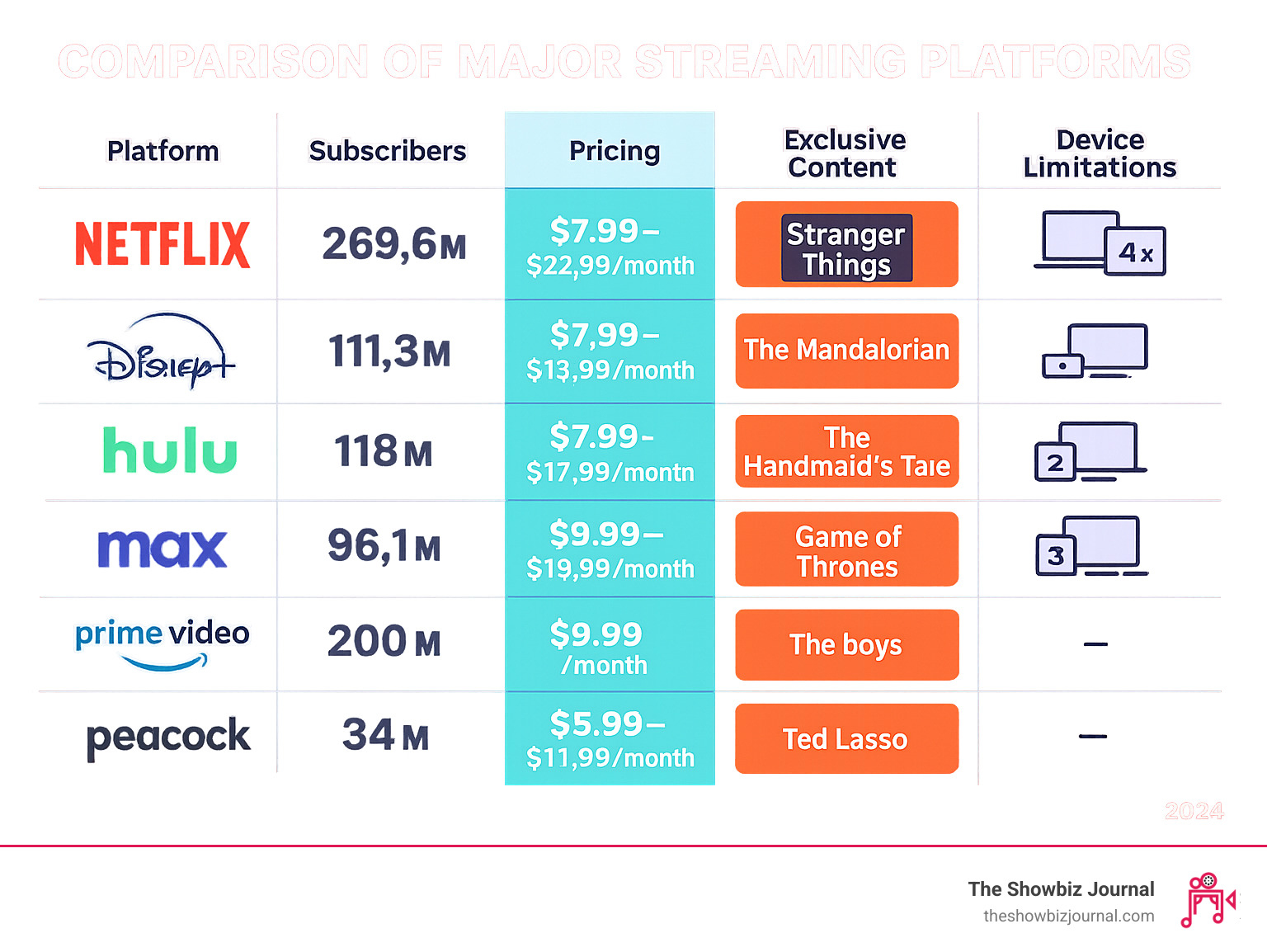
- Netflix: Largest platform with 269.6 million subscribers; plans from $7.99-$24.99/month
- Disney+/Hulu/ESPN+: Combined 229 million subscribers; bundle options from $10-$25/month
- Amazon Prime Video: 205 million subscribers; included with Prime ($139/year) or $9/month standalone
- Max (formerly HBO Max): Nearly 100 million subscribers; $10-$20/month
- Apple TV+: 50 million subscribers in 108 countries; $10/month
- Peacock: 34 million subscribers; $6-$12/month
- Live TV Options: YouTube TV, Hulu + Live TV, Fubo, Sling TV offering cable-like experience with no contracts
TV show streaming platforms have revolutionized how we consume entertainment, changing living rooms across the globe into personal theaters with unlimited content available at our fingertips. Gone are the days of rigid cable schedules and limited options – today’s viewers can access thousands of shows across dozens of services, anytime and anywhere.
The streaming landscape has exploded in recent years, creating both opportunity and confusion. With Netflix, Disney+, Hulu, Max, Prime Video, Apple TV+, Peacock and countless others vying for your subscription dollars, choosing the right platform can feel overwhelming.
As The New York Times noted about one aggregation service: “It essentially makes the app the center of your streaming universe, and in an increasingly convoluted digital media landscape, that’s a useful function indeed.”
This comprehensive guide will help you steer the streaming maze in 2024, comparing features, content libraries, pricing plans, and exclusive offerings across all major platforms. Whether you’re a binge-watcher, sports fan, movie buff, or family looking for kid-friendly content, we’ll help you find the perfect streaming solution.
The key differences between these platforms go beyond just price – each offers unique original programming, user experiences, and technical capabilities. Some excel at original content, while others focus on live TV or sports. Many now offer tiered plans with both ad-supported budget options and premium ad-free experiences.
What Are TV Show Streaming Platforms & How Do They Work?
Ever wondered how you can watch practically any show at the tap of a button? TV show streaming platforms are the magic behind this modern convenience – they’re online services that deliver video content directly over the internet, completely bypassing traditional cable, satellite, and broadcast TV.
Unlike the old days of television where every channel came flooding through your cable line at once (whether you were watching or not), streaming platforms send only what you’ve asked for. Think of it as the difference between having a fire hydrant blasting water non-stop versus turning on a faucet exactly when you need a drink.
This fundamental shift gives you incredible freedom:
You can watch your favorite detective show at 3 AM on Tuesday instead of waiting for its scheduled 8 PM Thursday slot. Your sister can binge an entire season of that baking competition in one sitting. Your roommate can pause mid-episode to grab snacks without missing a thing.
“Streaming platforms are essentially massive content delivery networks paired with sophisticated recommendation engines,” an industry insider recently explained to The Showbiz Journal. “The real magic happens when they can predict what you’ll want to watch next before you even know it yourself.”
From Cable to Cloud: Why TV Show Streaming Platforms Beat Traditional TV
Remember rushing home to catch your favorite show? Those days are gone, and most of us couldn’t be happier about it. TV show streaming platforms have flipped the script on how we consume entertainment.
The most obvious advantage is breaking free from rigid TV schedules. Traditional television forces you to adjust your life around when shows air. With streaming, the content waits for you, not the other way around.
Your wallet probably appreciates the change too. “I was paying over $150 for cable, but now I spend less than half that on streaming services and get exactly what I want,” one cord-cutter from Anaheim told us. Cable packages are notorious for making you pay for dozens of channels you’ll never watch, while streaming lets you pick and choose.
The content flexibility is another game-changer. Want to rewatch that show from your childhood? Curious about that series everyone was talking about five years ago? It’s all there waiting for you in vast digital libraries – no need to hope for reruns.
Perhaps most is how streaming has changed storytelling itself. Binge-watching entire seasons has become the new normal, and writers now craft shows with this in mind. Complex plots, deeper character development, and fewer repetitive recaps are all products of the streaming era.
Our research shows the average U.S. household now subscribes to 4.7 streaming services, spending around $47 monthly – significantly less than the typical $116 cable bill.
Under the Hood: Tech That Powers TV Show Streaming Platforms
While you’re comfortably watching your favorite show, an incredible technological orchestra is playing behind the scenes:
When you press play, Content Delivery Networks (CDNs) spring into action. These are massive systems of servers distributed globally that store copies of content close to viewers. When you watch “Stranger Things” in California, you’re likely connecting to a nearby server, not one at Netflix headquarters – making your viewing experience smooth and buffer-free.
Advanced compression codecs work their magic too, shrinking massive video files to manageable sizes without sacrificing quality. Technologies like H.265/HEVC and AV1 are why you can stream crystal-clear 4K video without needing industrial-strength internet.
Notice how streaming rarely buffers these days? Thank adaptive bitrate technology for that. These smart algorithms constantly monitor your connection and adjust video quality on the fly. Your picture might subtly shift between ultra-HD and slightly less sharp as your internet fluctuates, but you’ll rarely see that dreaded loading circle.
Perhaps most fascinating are the AI-powered recommendation engines that seem to read your mind. These systems analyze viewing patterns across millions of users to suggest content you might enjoy. Netflix famously categorizes shows into over 75,000 micro-genres through this technology. That’s why after watching one cooking competition, your homepage suddenly features five more.
“We’re processing exabytes of data daily to ensure that when someone in Anaheim hits play, the content starts in under 400 milliseconds,” a Netflix engineer revealed at a recent Hollywood tech conference. “That’s faster than you can blink.”
The technology has become so seamless, most of us barely think about it anymore – exactly as it should be. We just sit back, relax, and enjoy the show.
2024 Landscape of TV Show Streaming Platforms
The streaming world of 2024 looks nothing like the early days when Netflix stood nearly alone. Today, TV show streaming platforms have evolved into a rich, diverse ecosystem where giants compete alongside specialized services for your viewing time and subscription dollars.

Global Giants & Subscriber Numbers
The heavyweight champions of streaming have emerged with truly staggering global reach:
Netflix continues its reign as the undisputed king with 269.6 million subscribers worldwide. From its humble DVD-mailing beginnings, Netflix now offers plans ranging from $7.99 (with ads) to $24.99 monthly for premium 4K viewing. What’s particularly impressive is their content strategy – pouring over $17 billion annually into creating original shows that keep subscribers hooked month after month.
The Disney Bundle has become a formidable force by combining Disney+, Hulu, and ESPN+ into packages that serve 229 million subscribers. With monthly options from $10-$25, Disney leverages its treasure chest of beloved franchises – Marvel superheroes, Star Wars trips, Pixar heartwarming tales, and National Geographic explorations all under one digital roof.
Amazon Prime Video takes a different approach with its 205 million subscribers. Many viewers access it as just one benefit of their broader Amazon Prime membership ($139/year), though you can subscribe separately for $9/month. Amazon has been flexing its financial muscle with investments in prestigious content like “The Lord of the Rings: The Rings of Power” and expanding into live sports, making it more than just a shopping perk.
Max (the streaming service formerly known as HBO Max) has found its footing after the Warner Bros. Findy merger, gathering nearly 100 million subscribers. Priced between $10-$20 monthly, Max brilliantly combines HBO’s award-winning dramas with Findy’s reality content and Warner Bros.’ vast film library – offering something for every mood.
Apple TV+ proves that quality can triumph over quantity. Despite having a smaller content library than competitors, Apple’s beautifully produced originals and seamless integration with Apple devices has attracted 50 million subscribers across 108 countries, all paying $10/month for the privilege.
Peacock, NBCUniversal’s colorful contender, has secured 34 million subscribers with its $6-$12 monthly tiers. The platform cleverly leverages NBC’s broadcast favorites, Universal films, and live sports including extensive Olympic coverage that keeps viewers coming back.
Niche & Regional Stars
Not everyone needs to be everything to everyone – and that’s where specialized platforms shine:
Anime lovers have found their digital heaven with services like Crunchyroll, which delivers comprehensive libraries of Japanese animation often with same-day releases as Japan. As one subscriber told The Showbiz Journal, “Before these specialized platforms, finding legal ways to watch anime was nearly impossible. Now I can watch new episodes hours after they air in Tokyo.”
International content has exploded beyond borders with platforms dedicated to Korean dramas, Spanish telenovelas, and Bollywood blockbusters finding enthusiastic global audiences. These services often feature exclusive content you simply can’t find on the major platforms.
Genre enthusiasts now have dedicated homes too – horror fans flock to Shudder, while documentary devotees subscribe to CuriosityStream or MagellanTV for their factual fix. As one industry analyst explained to us, “These focused platforms thrive by deeply understanding and serving passionate fan communities rather than trying to please everyone.”
Live-TV Hybrids Gaining Ground
Perhaps the most interesting evolution is happening where streaming meets traditional television:
YouTube TV has reimagined cable for the digital age, offering 100+ channels, truly unlimited DVR storage, and innovative multi-view features for sports fans – all for $83/month without the equipment fees or installation headaches.
Hulu + Live TV creates a compelling one-stop solution by combining its extensive on-demand library with 95+ live channels, unlimited DVR (with 9-month storage), plus bundled Disney+ and ESPN+ for $82.99/month.
Fubo has carved out its niche by focusing on sports enthusiasts, delivering 215+ channels with 4K streaming options and multi-view capabilities that let you watch four games simultaneously for $85/month.
Budget-conscious viewers have found relief with Sling TV’s customizable channel packages starting at just $40/month, while Philo offers an ultra-affordable $28/month option with 70+ entertainment channels (though you’ll need to look elsewhere for sports and local news).
“I finally cut the cord last year,” shared a California subscriber to Hulu + Live TV. “Now I get all my local channels, sports, and on-demand shows in one place. The unlimited cloud DVR lets me record everything without worrying about storage, and I can actually skip commercials on recorded shows – something my old cable box made nearly impossible.”
The beauty of these hybrid services is how they’ve kept what people loved about traditional TV while eliminating the frustrations – no more contracts, hidden fees, or waiting for the cable guy. They’ve added cloud DVR, multi-device streaming, and interfaces that make finding what to watch genuinely enjoyable.
Comparing Features, Pricing & Plans
When it comes to TV show streaming platforms, the days of simple one-size-fits-all packages are long gone. Today’s streaming landscape offers a variety of subscription tiers that let you balance your budget against the features you really want.
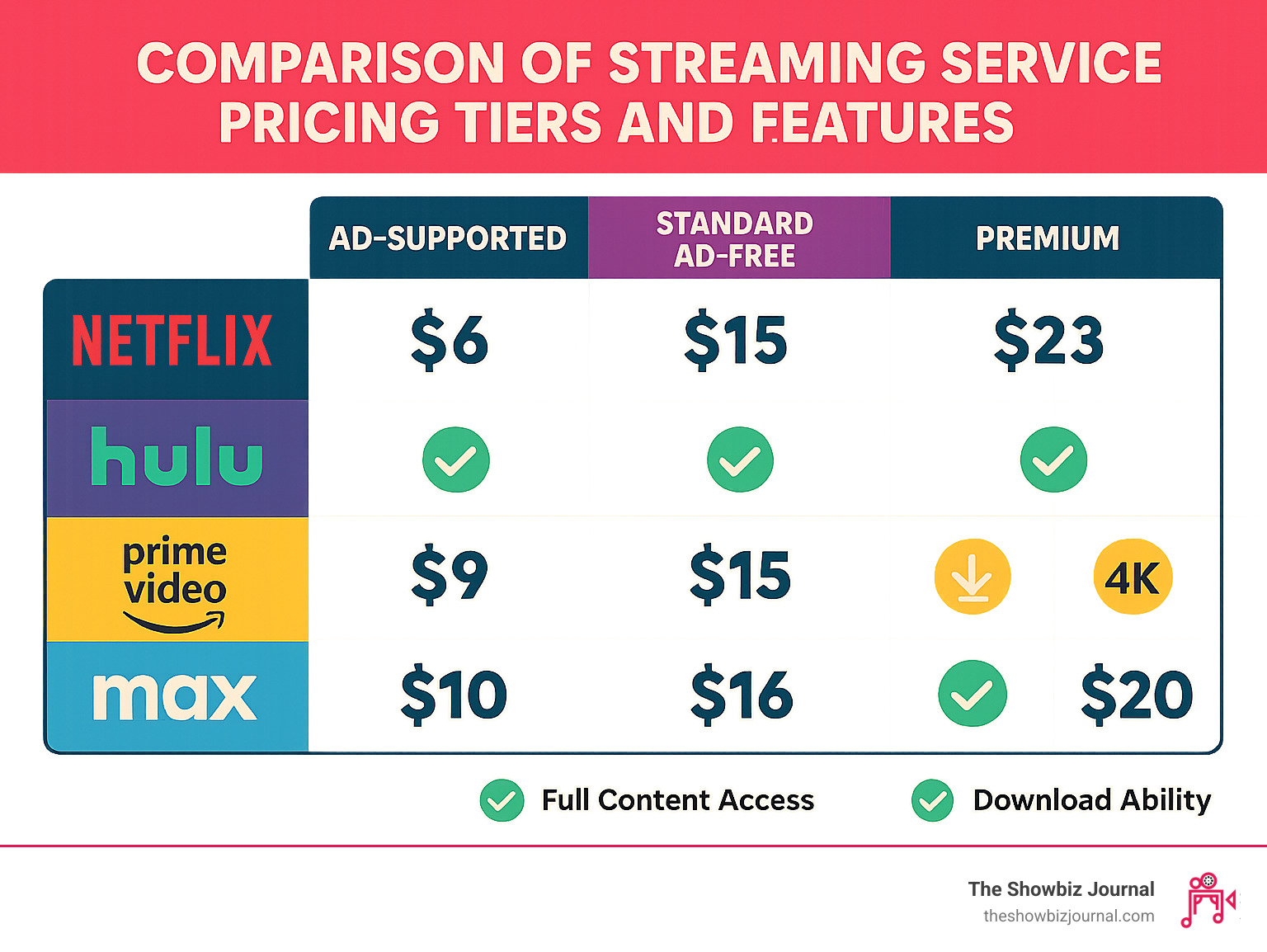
Most major platforms now structure their offerings in tiers that make a lot of sense once you understand what you’re getting. The Ad-Supported Basic plans ($5-$10 monthly) give you full access to content libraries but include commercial breaks – perfect if you’re budget-conscious and don’t mind the occasional interruption. Step up to a Standard Ad-Free tier ($12-$18 monthly), and those commercials disappear, plus you’ll usually get the ability to download shows for offline viewing.
For the ultimate experience, Premium tiers ($18-$25 monthly) open up the technical goodies: 4K/HDR streaming, immersive Dolby Atmos audio, and more simultaneous streams for households with multiple viewers. Many savvy streamers are also turning to Bundles like the Disney trio (Disney+, Hulu, ESPN+) that offer significant savings compared to subscribing separately.
“The era of growth-at-all-costs is over,” one streaming executive recently mentioned at a Hollywood industry conference I attended. “Profitability is now the priority, which means finding the right balance between value and revenue.” This explains why we’ve seen those price increases rolling in throughout 2023-2024.
Personalization & Finding Magic in TV Show Streaming Platforms
The real magic of TV show streaming platforms lies in how they learn what you like and create a viewing experience that feels custom just for you.
When you fire up Netflix after a long day, your homepage looks completely different from your neighbor’s. That’s because powerful algorithmic recommendations are working behind the scenes, analyzing your viewing history to suggest new shows you might love. Netflix actually attributes a whopping 80% of its viewed hours to these smart suggestions.
Creating customizable profiles for different family members means everyone gets their own personalized experience. My teenage daughter’s Netflix homepage is filled with teen dramas, while mine showcases documentaries and comedies – all under one account.
The small touches make a big difference too. That Continue Watching row that lets you pick up exactly where you left off, even if you switch from your TV to your phone? Pure convenience magic. And the ability to build watchlists means you’ll never forget that show your friend recommended when you finally have time to watch it.
“The goal is to make it feel like the service knows you better than a traditional TV channel ever could,” a Netflix product designer shared with me. “When you open Netflix, your homepage should feel completely different from your neighbor’s.”
Ad-Supported vs Ad-Free: Pros & Cons
The rise of ad-supported tiers has created an interesting choice for streamers, with clear tradeoffs on both sides.
Going with an ad-supported plan means keeping more money in your pocket – typically $3-$7 less per month than ad-free versions. You’ll still get access to the same great content library in most cases, and the commercial breaks are genuinely lighter than traditional TV (about 4-5 minutes per hour versus the 18-20 minutes you’d endure on broadcast television).
But those breaks can really disrupt the flow, especially during an intense drama or when you’re deep into a binge session. Many platforms also restrict features like downloads on their ad-supported tiers, and unlike DVR recordings, you can’t skip past the commercials.
Upgrading to ad-free means enjoying shows without interruption, downloading content for offline viewing, and avoiding the same ads playing repeatedly. The downside? That higher monthly bill.
“I started with the ad-supported plan to save money,” confessed one Hulu subscriber from Anaheim, “but the interruptions during intense drama episodes drove me crazy. I upgraded to ad-free and haven’t looked back. For comedies, I probably wouldn’t care as much.”
Live TV, Sports & DVR Extras
Sports fans and news junkies have special needs that streaming services are increasingly addressing with specialized features.
Unlimited DVR has become the new standard on services like YouTube TV, Hulu + Live TV, and Fubo, letting you record to your heart’s content without worrying about storage limits. Most platforms keep your recordings for about 9 months – plenty of time to catch up on that show everyone’s talking about.
For sports enthusiasts, Multi-View capabilities are a game-changer. “The multiview feature is a game-changer for football Sundays,” one Fubo subscriber told me. “I can keep an eye on four games at once, then switch to full screen when something exciting happens.”
Other premium features worth considering include 4K Sports broadcasts for the ultimate viewing experience, Catch-Up TV that lets you watch recently aired episodes without having recorded them first, and Regional Sports Coverage for following your local teams (though these often require premium tiers or add-ons).
Offline Viewing & Download Rules
As our viewing habits become increasingly mobile, the ability to download content for offline viewing has become essential for many subscribers.
Each platform has its own set of rules around downloads. You’ll typically face download limits on the number of titles you can store simultaneously (anywhere from 5-100 items depending on the service). Once you start watching, most downloads expire after 30-48 hours, while unwatched content usually stays available for 7-30 days before disappearing.
Many services offer quality options for downloads, letting you choose between standard and high-quality files to balance video quality against storage space. And watch out for device restrictions – most platforms limit how many devices can store downloaded content (typically 1-5).
“I download entire seasons before long flights,” shared one Apple TV+ subscriber who regularly travels between California and New York. “The 30-day expiration window is perfect since I can load up my iPad before a trip without worrying about downloads expiring too quickly.”
For frequent travelers, parents with kids who need entertainment on road trips, or anyone with spotty internet, these download features aren’t just nice-to-have – they’re essential.
Content & Device Checklist Before You Subscribe
Before committing to any TV show streaming platforms, take a moment to consider what really matters for your viewing experience. Think of this as your pre-subscription homework that could save you from disappointment later.

When it comes to content, each platform has carved out its own specialty. Netflix, Apple TV+, and Max have invested billions in creating must-watch original shows you won’t find anywhere else. If you’re nostalgic for classic network shows, Hulu maintains an impressive archive of favorites from years past. Movie buffs might lean toward Max and Prime Video with their extensive film libraries spanning decades of cinema.
Families with little ones should definitely consider Disney+, which reigns supreme in the kid-friendly content kingdom. Sports enthusiasts will want to look at ESPN+, Peacock, and Paramount+, each offering different leagues and events. And if you love international dramas and comedies, Netflix currently leads the pack with its global programming from dozens of countries.
“The content war is really about finding your tribe,” a streaming executive told us at a recent industry event in Hollywood. “No platform can be everything to everyone anymore, so they’re all leaning into their strengths.”
The technical details matter just as much as the content itself. While all major services now offer HD streaming, 4K and HDR availability varies widely—and sometimes carries premium pricing. Dolby Atmos sound support can transform your viewing experience but isn’t universal across platforms.
Perhaps most practically, pay close attention to simultaneous streaming limits. These range from just one device at a time to as many as four, which can make or break a service if your household has multiple viewers. Similarly, offline viewing capabilities differ dramatically between platforms, with some offering generous download limits and others restricting this feature to premium tiers.
Your existing devices should influence your decision too. While most TV show streaming platforms work across major brands, older smart TVs might not support newer services. Check compatibility with your specific models of Roku, Fire TV, Apple TV, or Chromecast devices. Gaming enthusiasts should verify PlayStation and Xbox support, and don’t forget to check mobile app availability for your iOS or Android devices.
As a streaming technology expert from Hollywood explained to us: “Device fragmentation is a major challenge for the industry. Each platform has to maintain apps across dozens of operating systems and hardware configurations, which is why you’ll occasionally find that a new feature rolls out to some devices months before others.”
Parental Controls & Kid Zones
For parents, content management tools can be just as important as the shows themselves. Today’s TV show streaming platforms offer sophisticated options to keep children safely entertained.
Most services now provide profile-based restrictions that create walled gardens of age-appropriate content. These kid-specific profiles typically feature simplified interfaces with larger icons and easier navigation designed specifically for younger viewers.
PIN protection has become standard on adult profiles, preventing curious kids from accessing mature content when parents aren’t looking. Some platforms take this further with time limits that automatically cut off viewing after a set period—a feature that Disney+ has particularly refined.
The granularity of content ratings filters varies widely between services. Netflix currently leads with the most customizable options, allowing parents to set specific maturity levels for each profile. Meanwhile, Disney+ offers perhaps the most comprehensive overall package of parental controls combined with its best library of family content.
A parent from Anaheim shared her experience: “The kids’ profiles are a lifesaver. My children can steer their own Disney+ account without me worrying they’ll stumble onto something inappropriate, and the simplified interface means they can find their favorite shows without help.”
Region Locks & VPN Realities
The global nature of TV show streaming platforms comes with some geographical complications worth understanding before you subscribe.
Content libraries vary dramatically by country due to complex licensing agreements. A show available in the US might be completely absent from the same service in Canada or the UK. This can be particularly frustrating when traveling, though most services do allow temporary access while abroad—just don’t expect to find exactly the same selection.
Many viewers have turned to Virtual Private Networks (VPNs) to bypass these restrictions, but the major platforms have gotten wise to this approach. Most actively block known VPN connections, making this workaround increasingly unreliable.
The industry has also cracked down on account sharing across households. Netflix pioneered this effort, implementing technical measures to detect and restrict password sharing beyond immediate family members living together.
A Netflix representative clarified their policy during a recent press briefing: “We want to make it easy for members who share their home with family to do so, while cracking down on those sharing outside their household.”
Understanding these geographical and sharing limitations can help set realistic expectations before you commit your monthly streaming budget to any particular platform.
Tips & Tools for Finding Where to Stream Any Show
With content spread across dozens of services, finding where to watch specific shows has become increasingly challenging. Fortunately, several tools have emerged to simplify the search:
Aggregator Services: Platforms like JustWatch, Reelgood, and Plex aggregate content across services, allowing you to search once to find where a show is streaming.
Universal Watchlists: Services that create a single watchlist across all your subscriptions, notifying you when new episodes are available or when a show changes platforms.
Price Trackers: Tools that monitor subscription costs and alert you to promotional offers or price increases.
As JustWatch explains: “We are glad you’re here! With JustWatch you can easily find out where to watch your favorite movies & TV shows in the United States.”
Using Aggregators to Locate TV Show Streaming Platforms Fast
Aggregator services have become essential navigation tools in the fragmented streaming landscape:
Unified Search: Enter a show name once to find which of your subscriptions offers it.
New Addition Alerts: Notifications when services add shows to their libraries.
Watchlist Management: Track shows across platforms in a single interface.
Personalized Recommendations: Suggestions based on your viewing preferences across all services.
One JustWatch user from California told us: “Before using an aggregator, I’d waste 15 minutes checking each app individually to find if a movie was streaming somewhere. Now I can search once and jump directly to the right platform.”
Bundling & Saving on Multiple TV Show Streaming Platforms
Strategic subscription management can significantly reduce streaming costs:
Official Bundles: Packages like the Disney Bundle (Disney+, Hulu, ESPN+) offer savings of 30-40% compared to individual subscriptions.
Telecom Partnerships: Many cellular and internet providers offer free or discounted streaming services with their plans.
Annual Billing: Most platforms offer 15-20% discounts for annual versus monthly payments.
Student Discounts: Services like Hulu, Paramount+, and Apple TV+ offer reduced rates for verified students.
Hardware Promotions: New device purchases (Apple products, Roku players, smart TVs) often include free trial periods for premium services.
A savvy subscriber from Hollywood shared her strategy: “I rotate subscriptions seasonally. I’ll subscribe to Max when ‘House of the Dragon’ is airing, then cancel and switch to Apple TV+ when ‘Ted Lasso’ returns. For services with annual plans, I wait for Black Friday deals to lock in the lowest rates.”
Decision Checklist: Finding the Best TV Show Streaming Platform for You
When choosing between TV show streaming platforms, consider these key factors:
- Budget: Determine your monthly entertainment budget and prioritize accordingly
- Must-Watch Content: Identify which platforms host your non-negotiable favorite shows
- Viewing Habits: Consider how, when, and where you typically watch (binge vs. weekly, mobile vs. TV)
- Technical Requirements: Evaluate your internet speed, device compatibility, and quality preferences
- Household Size: Factor in how many simultaneous streams you need
- Content Findy: Consider which interfaces and recommendation engines you find most intuitive
- Special Features: Prioritize unique features that matter to you (downloads, 4K, etc.)
As one streaming industry consultant told The Showbiz Journal: “The perfect streaming setup is highly personal. For some viewers, a single service might be enough. Others might need three or four to cover all their interests. The key is being intentional about your choices rather than accumulating subscriptions endlessly.”
Frequently Asked Questions about TV Show Streaming Platforms
Are streaming platforms cheaper than cable long-term?
When it comes to your entertainment budget, TV show streaming platforms typically offer significant savings compared to traditional cable packages. The numbers tell a compelling story: the average cable package hits your wallet for about $116 monthly, while most households spend around $47 on their streaming services.
“I was skeptical at first about cutting the cord,” admits James, a former cable subscriber from Anaheim. “But even with Netflix, Disney+, and Hulu + Live TV, I’m pocketing about $40 extra each month. Plus, I never have to deal with those frustrating equipment rental fees or wait around for installation technicians anymore.”
The savings can disappear quickly, though, if you find yourself collecting subscriptions like trading cards. The secret to maximizing your streaming budget is being intentional about which services you keep active. Many savvy viewers have adopted a seasonal rotation strategy – subscribing to HBO Max when “House of the Dragon” is airing, then switching to Apple TV+ when “Ted Lasso” returns, rather than maintaining all services year-round.
Which services let me watch live sports without cable?
Sports fans, rejoice! The days of needing cable to catch your favorite teams are firmly behind us. TV show streaming platforms now offer robust sports coverage through several options:
For comprehensive sports coverage, the heavyweight contenders include Hulu + Live TV ($82.99/month), which delivers ESPN, Fox Sports, CBS Sports, and NBC Sports in one package. YouTube TV ($83/month) similarly offers an impressive sports lineup including ESPN and regional networks. True sports enthusiasts often gravitate toward Fubo ($85/month), which specializes in sports with 118+ dedicated networks.
If you’re only interested in specific leagues, more affordable options exist. ESPN+ ($11/month) covers NHL, MLB, MLS, and college sports, while Paramount+ ($6-12/month) brings you NFL, UEFA Champions League, and SEC football. Peacock ($6-12/month) has become the home for Premier League soccer, Sunday Night Football, and Olympic coverage.
Baseball fans should note that Apple TV+ ($10/month) now offers Friday Night Baseball and MLS Season Pass, though some matches may require additional fees.
“Finding regional sports networks was my biggest concern when leaving cable,” shares Michael, a basketball fan from California. “Fubo solved that problem for me – I haven’t missed a single Lakers game since switching.”
How many devices can stream at once on most platforms?
Family harmony often depends on how many simultaneous streams your chosen TV show streaming platforms allow. This limit varies significantly between services and subscription tiers:
Netflix scales its offering based on your plan: just 1 device for Basic with ads, 2 devices with the Standard plan, and a generous 4 devices with Premium. Disney+ keeps it simple with 4 simultaneous streams across all plans, making it family-friendly by default. Hulu provides 2 concurrent streams on standard plans, but offers an unlimited in-home streaming add-on for $10/month if you have a busy household.
Max follows a tiered approach with 2 devices for Basic with ads and Standard plans, increasing to 4 devices with Premium. Apple TV+ stands out with a generous 6-device limit, while Prime Video (3 devices), Peacock (3 devices) and Paramount+ (3 devices) all offer similar mid-range options.
For those replacing cable with live TV streaming services, YouTube TV allows 3 simultaneous streams, Hulu + Live TV offers 2 (or unlimited with that same $10 monthly add-on), and Fubo provides an impressive 10 devices on your home network plus 3 outside the home.
“Our family of five was constantly negotiating screen time with our old streaming setup,” explains Sarah, a Max subscriber from Portland. “Upgrading to the Premium plan with four simultaneous streams was a game-changer. The kids can watch on their tablets while my partner and I enjoy different shows on our respective devices. No more ‘who gets the TV’ arguments!”
Conclusion
The world of TV show streaming platforms continues to evolve at a breathtaking pace. New services pop up regularly, existing ones merge, and our favorite shows jump between platforms like fickle houseguests. While this fragmentation can sometimes feel overwhelming, it also gives us more choice and flexibility than we’ve ever had before.
Throughout this guide, we’ve seen that there’s no one-size-fits-all solution when it comes to streaming. Your perfect setup depends entirely on what you love to watch, the devices you own, and how much you’re willing to spend each month. Some families might find all they need in a single service, while others might mix and match platforms to cover their diverse entertainment appetites.
If there’s one thing I’ve learned covering streaming trends from our Hollywood offices, it’s that being strategic about your subscriptions can save both money and frustration. Here are the most valuable lessons for navigating today’s complex streaming landscape:
Be intentional with your choices. Subscribe based on shows you’ll actually watch, not just because everyone’s talking about a platform. That buzzy new series might not be worth the subscription if it’s the only thing you’ll watch.
Accept aggregator tools like JustWatch. These free services can save you countless hours of frustration by instantly showing you where to find that movie or show you’re craving.
Consider rotating your subscriptions seasonally. There’s no rule saying you need to maintain every service year-round. Many viewers subscribe to Max when House of the Dragon is airing, then pause until the next must-see show premieres.
Look for bundle opportunities that can dramatically cut your costs. The Disney+/Hulu/ESPN+ bundle and mobile carrier partnerships often offer significant savings over à la carte subscriptions.
Reassess your streaming lineup regularly. As content libraries shift and your viewing habits evolve, the perfect mix of services will likely change too. What worked last year might not be ideal today.
We’re living in what I like to call the platinum age of streaming – beyond even the golden age of television. There’s simply more exceptional content available today than any person could possibly consume in a lifetime. The challenge isn’t finding something great to watch anymore; it’s making smart choices about which streaming services deserve your time and money.

At The Showbiz Journal, we’re committed to helping you steer these waters. We’ll continue monitoring the evolving streaming landscape, bringing you insider interviews, breaking news, and thoughtful reviews of platforms and features as they emerge.
For more coverage of the latest TV shows, streaming developments, and entertainment industry news, visit The Showbiz Journal’s TV section.

About the author
Annelise Sylta
Annelise Sylta is a member of the editorial staff at The Showbiz Journal. She holds an MBA from FIDM and brings a professional background in marketing, communications, branding, and audience engagement to her work with the publication. Her experience provides an additional perspective on the intersection of entertainment, culture, media, and contemporary lifestyle.
Up next


